In 1925, the physicist Ernst Ising studied how tiny magnets interact with one another. The results disappointed him so much that he left physics. More than 20 years later he learned, by chance, that his “failure” already had a name of its own, the Ising model, and had become one of the most famous models in physics.
Today the model bearing his name is used far beyond physics, among other things in mathematical optimisation problems.
What do magnets have to do with ERP?
In my day job I develop an ERP system for manufacturing companies, and I know one thing: in a factory it is hard to make a decision that doesn’t affect something else. We have limited resources, conflicting goals and countless dependencies. A solution that is good for one area is not necessarily the best for the whole organisation.
Ising’s magnets are similar. Each can take one of two states, and its orientation affects the others. The whole system tends towards the configuration with the lowest possible energy.
Hence the idea: what if certain business problems were written down as a system of interacting magnets? Mathematically, it is possible. What’s more, quantum computers may turn out to be particularly effective at solving such problems. Whether they will beat classical algorithms is still an open question.
How a magnet turns into a decision
A physicist describes such a system with a single expression, its energy:
Here is the direction of a magnet (up or down). says whether two magnets prefer to align in the same or opposite directions, and how strongly. And is an external field that pushes a single magnet one way.
Now all it takes is swapping the words:
- the direction of a magnet is a yes/no decision,
- the interaction is the cost or benefit of making two decisions together,
- the external field is the cost of a single decision,
- the lowest energy is the best set of decisions taken all at once.
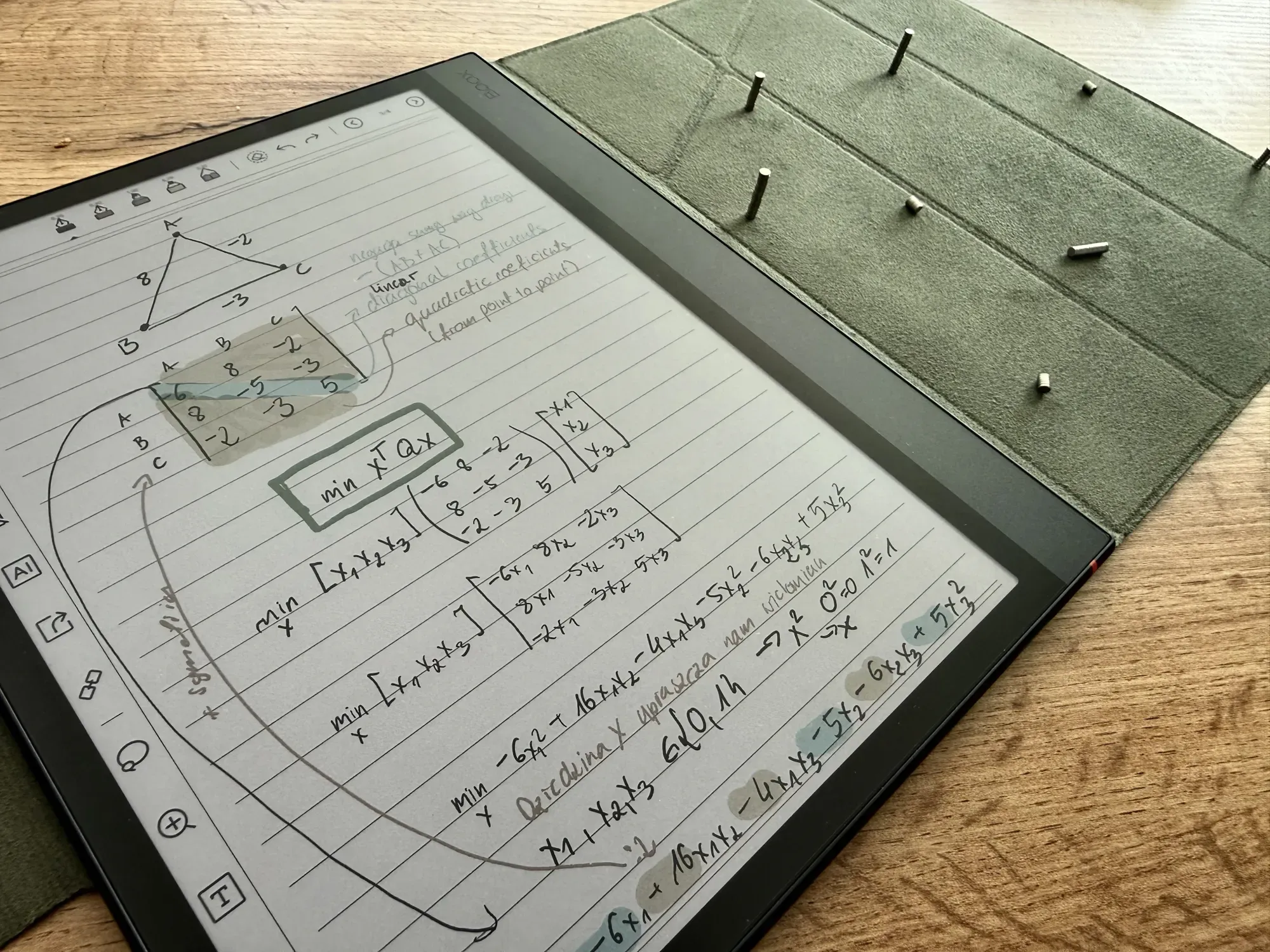
From magnets to QUBO
A simple change of variables turns the magnets into ordinary bits (0/1) and the energy into a quadratic function of bits:
In computer science this is called QUBO (Quadratic Unconstrained Binary Optimization). And here is the crux: the same formulation describes the problem of choosing the best combination out of possible ones.
Why it’s hard
Because you can’t satisfy every pair at the same time. With a few hundred decisions, the number of combinations exceeds the number of atoms in the universe, and getting one pair right breaks another. Physicists call this frustration; managers call it conflicting goals.
What surprises me most is that the same formula can describe a system of magnets and, at the same time, decisions in a factory. A hundred years ago this equation described iron. Whether it can describe a factory well enough to base real optimisation on it, or whether it’s just a neat analogy, is worth testing on concrete problems.