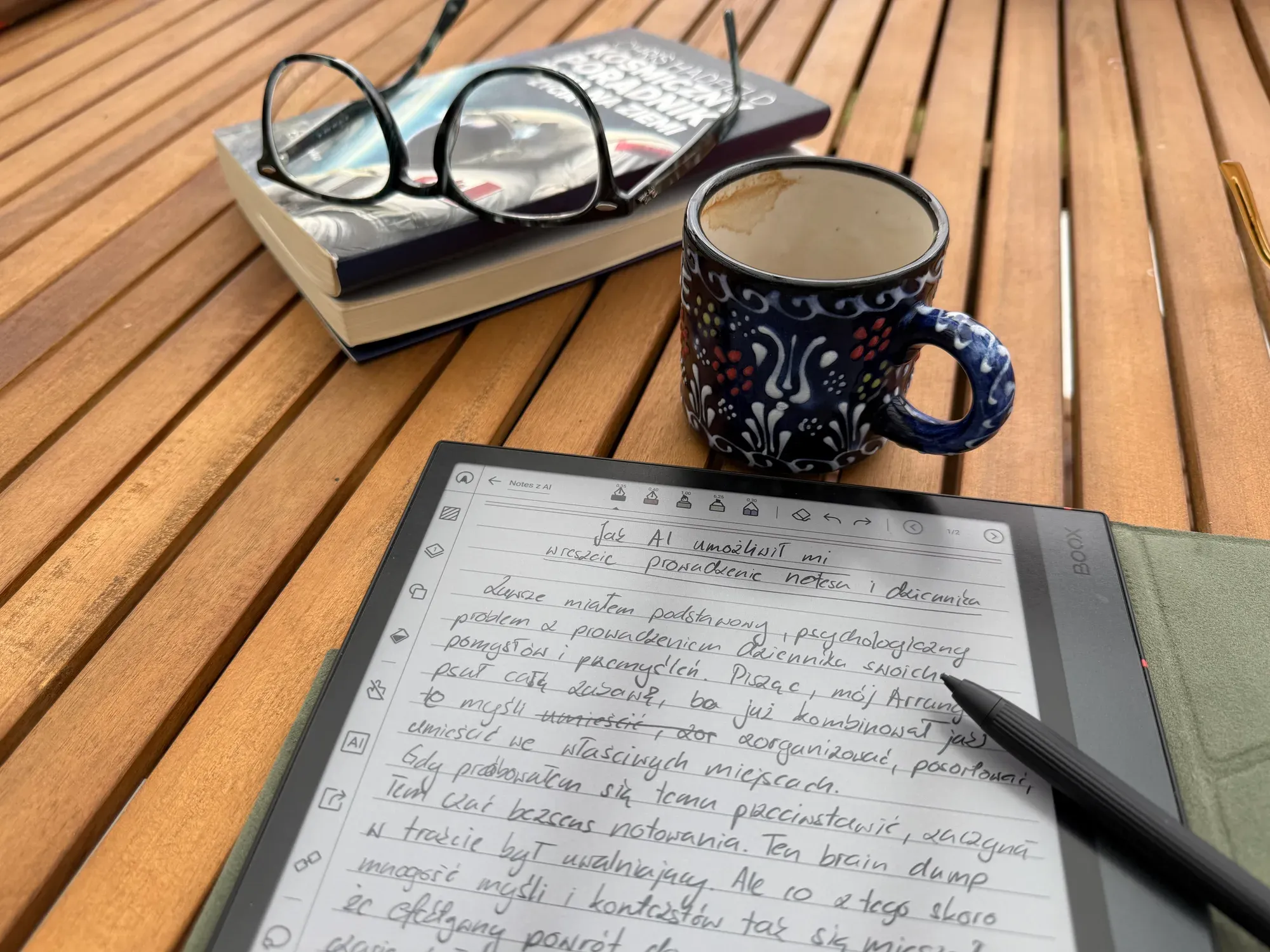
For as long as I can remember, the more notes I took, the less useful my notebook became, whether paper or electronic.
For years I had a fairly serious problem with keeping a notebook and writing down ideas and thoughts. It wasn’t a lack of discipline, and it wasn’t that I disliked writing. Quite the opposite. The problem began at the exact moment I finished writing down a valuable thought.
My inner organiser would immediately get to work. And start scheming. Where should I put this? How will I find it again later? Which project does it belong to? Maybe it needs its own notebook, maybe its own page?
Instead of simply writing the thought down, I started wondering how to organise it so I wouldn’t lose it later.
I tried to deal with this in various ways.
The best one is the classic brain dump: writing everything down in order, without thinking about structure. While writing, it worked brilliantly. It is even liberating for your head. You throw out one idea, observation and reflection after another without worrying about where they belong. Your only marker is the date.
But… after a few weeks a single notebook was a mix of work projects, private matters, ideas, to-dos and loose reflections. I knew I had written down an important thought somewhere, but finding it meant digging through page after page. By nature I don’t like looking for things. When I lose something, I wait for it to turn up on its own.
Over time I came to feel that just pulling the information out, rebuilding its context and gathering the related thoughts sometimes took longer than coming up with the thought again from scratch.
I also tried the opposite approach: separate notebooks for different projects and contexts.
Unfortunately… some notebooks filled up quickly while others stayed almost empty for months. Then there was another problem: you carry all of them around, and before I could write anything down, I again had to decide where the thought belonged.
The problem is not having to think and organise at the same time out of fear of losing something.
When an idea comes, you need to write it down quickly. Not think about the category, the project or the tab at that moment. At the same time, you need to be confident that the thought won’t get lost among many others.
Sooner or later, every note-organising system I had used forced me either to categorise immediately or to do periodic reviews. I don’t like tasks of the “every week we go back, review and tidy up” kind. It is a waste of time. I would rather the notes showed up in the right place at the right time, when I need them.
And this is where Claude AI came in. It let me focus on taking notes while it took over the job of organising and building my so-called second brain.
I do the thinking and writing. AI does the organising later.
Today I use several tools, but each of them has a very specific role.
I write by hand on an Onyx Boox e-ink notebook. The way I take notes is loosely inspired by bullet journaling. My target knowledge repository (my second brain) is Obsidian, where I keep notes in Markdown and organise them using the PARA system developed by Tiago Forte. The next level of knowledge, my team’s knowledge, lives in OneDoc.
The most important change, however, is not about any of these tools. It is about how AI glues them together.
I keep one notebook per month. Everything goes in there: an idea for a project, a to-do, a loose reflection, meeting notes, an idea I want to try some day, improvements, new products. I don’t think about where a piece of information should end up later. I just write it down.
Once a month I hand the whole notebook over to Claude. The AI goes through my notes and splits them into a few basic areas: projects, to-dos, resources and journal. On top of that, every paragraph gets a link to the corresponding page in the PDF, so I can always get back to my source.
Then, in a second pass, based on those .md files, I ask it to pull out the information that matters in the long term and put it in the right places in my Obsidian vault.
So a monthly notebook can hold, side by side, notes on a work project, a book I want to read, a private reflection, new ideas and a task to do. All the boring work of taking that notebook apart is done by artificial intelligence.
There is a lot of talk about AI writing texts and suggesting ideas. For me, the greater value of AI is in less spectacular work: organising, classifying and putting information away where I will need it later. I think, create and write things down, and then an agent puts them where I will look for them.
If you feel this article is missing something, let me know in the comments. I’ll reply or send you the details privately.